مقدمة
Biomolecular medicine is undergoing its most dramatic transformation in decades. In 2026, the convergence of artificial intelligence, nanotechnology, and advanced cellular biology is producing therapies that were considered science fiction just a few years ago. At BCRMED Global, we are at the forefront of this revolution — applying cutting-edge biomolecular science to restore organ function and address chronic disease at its root. Here are seven breakthroughs you need to know about.
1. AI-Designed Peptides Are Accelerating Drug Discovery
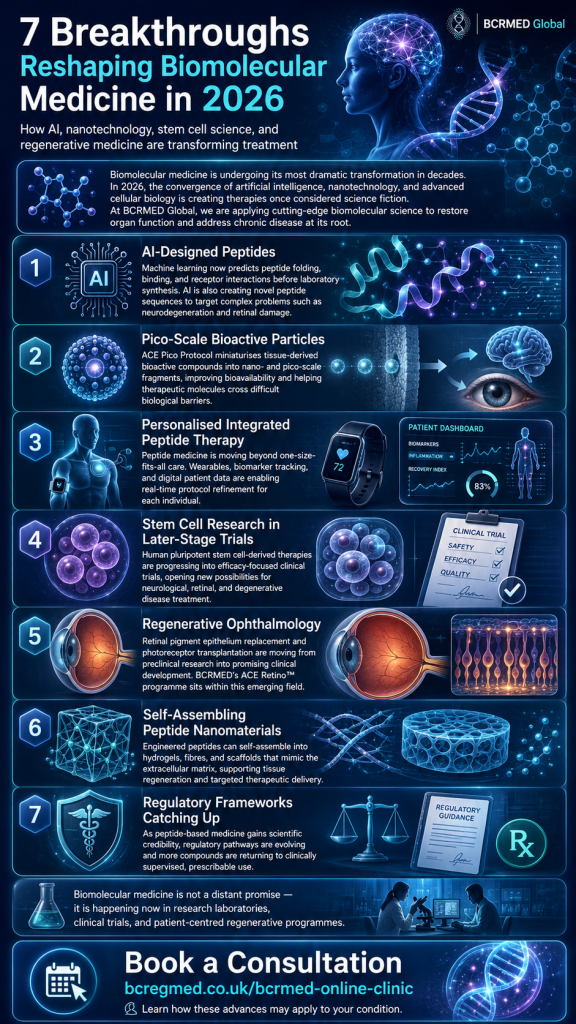
Machine learning algorithms can now predict how a peptide will fold, bind, and interact with a cell receptor before it is ever synthesised in a laboratory. What previously took years of trial and error now takes months of computational modelling. AI is also designing entirely novel peptide sequences — ones that do not exist in nature — specifically engineered to target difficult biological problems such as neurodegeneration or retinal damage.
2. Pico-Scale Bioactive Particles Are Unlocking New Therapeutic Possibilities
At BCRMED, our proprietary ACE Pico Protocol processes tissue-derived bioactive compounds into nanometer and picometer-scale fragments. This miniaturisation dramatically increases bioavailability — the ability of these molecules to cross biological barriers and reach target tissues. Where conventional therapies struggle to penetrate the blood-brain barrier or the ocular surface, pico-scale particles open entirely new routes of delivery.
3. Peptide Therapy Is Moving Toward Integrated, Personalised Protocols
The era of one-size-fits-all treatment is ending. In 2026, the trend in peptide therapy is toward integrated treatment plans that address multiple biological systems simultaneously. Clinicians are pairing peptide protocols with digital monitoring tools — wearables, continuous biomarker tracking, and patient data platforms — to refine protocols in real time and optimise outcomes for each individual patient.
4. Stem Cell Research Is Entering Later-Stage Clinical Trials
A 2025 landscape analysis reported 115 regulatory-approved clinical trials testing human pluripotent stem cell-derived products, with more than 1,200 patients dosed and no generalised safety concerns identified. This marks a pivotal shift from early feasibility studies to trials designed to demonstrate efficacy — a transition that is opening the door to stem cell therapies for conditions ranging from neurological degeneration to retinal disease.
5. Regenerative Ophthalmology Is Emerging as a Distinct Clinical Field
Regenerative medicine is making rapid inroads into ophthalmology. Stem cell therapies for retinal diseases have transitioned from preclinical investigation to early-phase clinical trials with promising results. Both retinal pigment epithelium replacement and photoreceptor transplantation strategies have shown potential to preserve or restore visual function in conditions once considered irreversible. BCRMED’s ACE Retino™ programme sits squarely within this emerging field.
6. Self-Assembling Peptide Nanomaterials Are Transforming Tissue Engineering
A major frontier in biomolecular medicine involves peptides that spontaneously self-assemble into ordered nanostructures — hydrogels, fibres, and scaffolds that mimic the body’s own extracellular matrix. These materials are proving highly suited for regenerative applications because they can be designed to biodegrade safely, respond to their environment, and carry therapeutic cargo to specific tissues. Research published in the Journal of Peptide Science in 2026 highlights their potential for targeted therapeutic delivery and tissue regeneration.
7. Regulatory Frameworks Are Catching Up With Innovation
In 2026, approximately 14 previously restricted peptide compounds are expected to regain legal, prescribable status through licensed pharmacies following new guidance from health authorities. This regulatory normalisation signals growing scientific and institutional confidence in peptide-based medicine. It also reinforces the importance of sourcing therapies from regulated, clinically overseen providers — exactly the standard BCRMED upholds in all its programmes.
Conclusion
Biomolecular medicine is not a distant promise — it is happening now, in clinical trials, in research laboratories, and in the treatments we offer at BCRMED Global. If you would like to learn more about how these advances apply to your condition, contact our clinical team or book a consultation through our online clinic.
Call to Action: Book a Consultation at bcregmed.co.uk/bcrmed-online-clinic
RegenerativeMedicine #BCRMED #ACEFactor #AntiAging #CellularHealth #StartNow #HealFromWithin #BetterHealthStartsToday