مقدمة
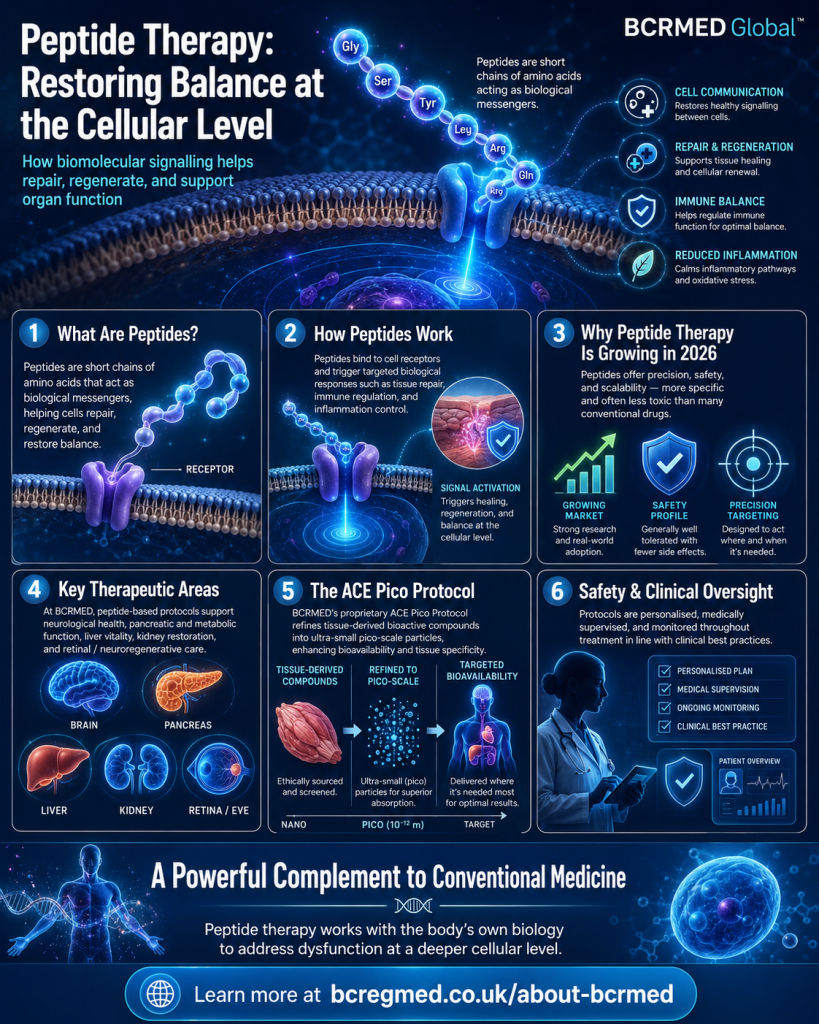
Peptides are short chains of amino acids — the same building blocks that make up proteins. But unlike large protein molecules, peptides are small enough to communicate directly with individual cells, acting as biological messengers that instruct the body to repair, regenerate, and restore balance. Peptide therapy harnesses this natural signalling system to address the root causes of chronic disease rather than merely managing symptoms.
How Peptides Work in the Body
Every cell in your body receives instructions through molecular signals. Peptides are among the most important of these signals — they bind to receptors on cell surfaces and trigger specific biological responses, from stimulating tissue repair to regulating immune function and modulating inflammation. Because they mimic signals the body already produces, well-designed peptide therapies work with the body’s own biology rather than overriding it.
Why Peptide Therapy Is Growing in 2026
The peptide therapeutics market is projected to nearly double over the next decade. The reason is straightforward: peptides occupy a unique position in medicine. They are more specific and less toxic than conventional small-molecule drugs, but smaller and more cost-effective to manufacture than complex biologics such as antibodies. This combination of precision, safety, and scalability is driving rapid adoption across multiple therapeutic areas.
Conditions That Peptide Therapy Can Address
At BCRMED, we use peptide-based protocols across five major therapeutic areas: neurological health, pancreatic and metabolic function, liver and hepatic vitality, kidney restoration, and retinal and neuroregenerative conditions. Each of these areas involves biological dysfunction at the cellular and molecular level — precisely the domain in which peptide signalling operates most effectively.
The ACE Pico Protocol: BCRMED’s Proprietary Approach
Our ACE Pico Protocol represents a significant advance in peptide delivery. By refining tissue-derived bioactive compounds into ultra-small pico-scale particles, we dramatically increase the bioavailability and tissue specificity of our formulations. The result is a concentrated matrix of peptides, growth factors, and organotropic complexes designed to support regeneration in specific organ systems.
Safety and Clinical Oversight
All BCRMED peptide protocols are developed in accordance with clinical best practices and administered under medical supervision. We adhere to guidelines from the British National Institute for Health and Care Excellence (NICE) and the American Medical Association. Patients receive personalised assessments before any protocol begins, and progress is monitored throughout treatment.
Conclusion
Peptide therapy is not a replacement for conventional medicine — it is a powerful complement to it, addressing biological dysfunction at a level that conventional treatments often cannot reach. To find out whether peptide therapy is appropriate for your condition, speak with our clinical team.
Call to Action: Learn more at bcregmed.co.uk/about-bcrmed
RegenerativeMedicine #BCRMED #ACEFactor #AntiAging #CellularHealth #StartNow #HealFromWithin #BetterHealthStartsToday