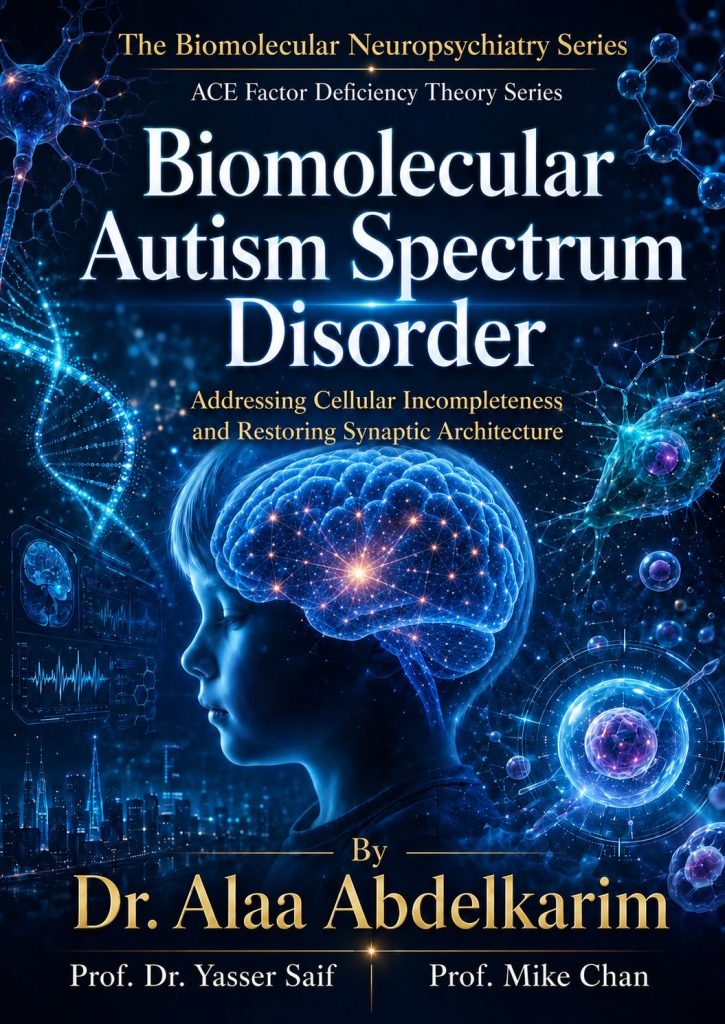
This book asks one central question: are the cellular abnormalities of ASD the result of irreversible destruction — or of incomplete development that, given the right biological inputs, could be completed? The authors argue the evidence supports incompleteness, and that this distinction has profound therapeutic consequences.
THE SCIENTIFIC FRAMEWORK
Chapter I establishes the ACE Factor Deficiency Theory: health requires every cell to have access to every biological factor it needs to run its biochemical cycles. When inflammation depletes essential trace elements and damages mitochondria, those cycles fail. Classic medicine proves this repeatedly — scurvy, PKU, pernicious anaemia — each caused by a single missing factor, each reversed by supplying it. The theory extends this logic to ASD, where the missing factors may not yet all be named or measured.
Chapter II documents ASD’s global scale: approximately 1 in 36 children in the US, with rising prevalence worldwide driven primarily by broader diagnostic criteria. The condition affects males roughly 4 times more than females and co-occurs frequently with epilepsy, ADHD, and anxiety.
Chapters III and IV build the molecular case: ASD is a synaptopathy — a disorder of synapse formation and circuit calibration during foetal brain development. Key proteins are deficient: SHANK3, NRXN1, NLGN3 in the synaptic scaffold; BDNF and the neurotrophin family in neurotrophic signalling; GAD67 in inhibitory interneuron maturation; NRG1 in myelination. Mitochondrial dysfunction impairs energy production across all repair processes. This is not brain damage. It is atypical brain construction.
THE CENTRAL HYPOTHESIS
Chapter V presents the Regenerative Cellular Incompleteness Hypothesis. Every ASD cellular deficit corresponds, item by item, to a peak-expression element in embryonic foetal brain tissue — because the embryonic brain is actively building the very structures ASD failed to complete. This is not analogy. It is a direct molecular match between the documented deficit and the documented supply.
THE PROPOSED APPROACH
Chapter VI describes the ACE Pico Protocol: a sub-micron processed extract of foetal sheep brain cells with a mesenchymal stem cell secretome component, delivered sublingually. Sub-micron processing generates bioactive peptide fragments and extracellular vesicle-rich preparations small enough to cross mucosal barriers — enabling home-based, pain-free, multiple-daily dosing over months. A pilot murine study confirmed sublingual delivery produces systemic protein absorption comparable to intramuscular injection. Preliminary uncontrolled observations in six children with ASD (ages 5–7, non-verbal to high-functioning) showed sustained functional improvements in social, communicative, and behavioural domains at 6–12 months, across different subtypes — consistent with a common cellular mechanism.